


If the same workplace safety violations appear on OSHA’s Top 10 list every year, they’re not surprises — they’re preventable failures.
Each year, OSHA releases its Top 10 Most Frequently Cited Workplace Safety OSHA Violations, and year after year, the same hazards dominate the rankings. According to OSHA’s official data, these standards consistently represent the most cited violations across industries (https://www.osha.gov/top10citedstandards).
These are not new or emerging risks. They are well-documented, well-understood dangers that continue to result in injuries, fatalities, and significant financial penalties.
At first glance, the list may look like a simple compliance ranking. But a closer look — especially alongside the financial consequences employers face — reveals something far more important: the most common hazards are also the most predictable. And predictable hazards are preventable.
Understanding Workplace Violations and Safety Risks
The chart below highlights the most frequently cited OSHA violations.
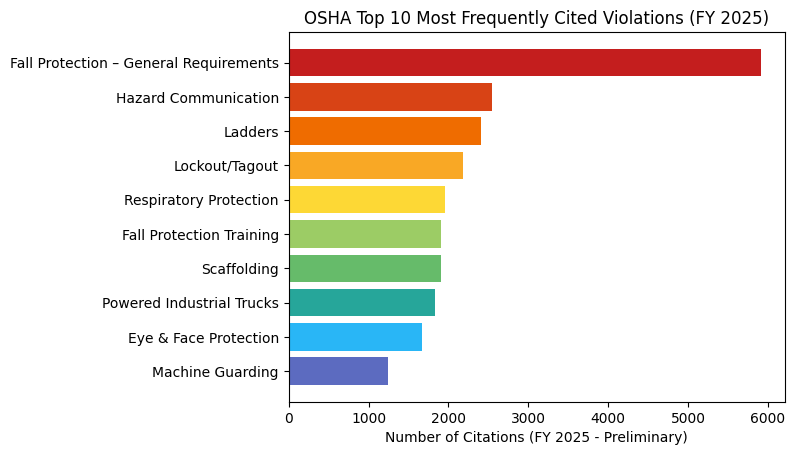
- Fall Protection consistently ranks as OSHA’s most frequently cited violation, followed by Hazard Communication, Ladders, Scaffolding, and Lockout/Tagout.
- These are not new or emerging hazards. They are long-standing, well-documented risks.
- Mastering the fundamentals reduces the majority of workplace risk.
Lesson #1: Safety breakdowns usually stem from execution gaps — not missing regulations.
When the same violations appear annually, it signals inconsistent training, supervision, or enforcement.
Citation counts shown are rounded for illustrative purposes. For exact annual figures, see OSHA’s official Top 10 list at osha.gov/top10citedstandards. & OSHA’s Top 10
Training Programs for Workplace Violations and Safety Compliance
Many of OSHA’s most common violations trace back to one root cause: insufficient or ineffective training.
When employees are not properly trained, they may:
- Misuse or improper inspection of fall protection systems
- Bypass or incorrectly apply lockout/tagout procedures
- Misinterpret hazard communication labels and Safety Data Sheets
- Operate equipment without fully understanding associated risks
Lesson #2: Policies alone do not prevent injuries — education and hands-on training do. The most effective safety programs go beyond written procedures. They equip employees with practical knowledge, reinforce safe behaviors, and hold supervisors accountable for compliance.
Preventing repeat OSHA citations requires more than written policies — it demands consistent safety awareness, hands-on instruction, and accountability at every level of the organization. At LBA University, we provide targeted, compliance-focused safety training programs specifically designed to address the OSHA violations most frequently cited across industries — helping organizations turn predictable hazards into preventable outcomes.
Recommended courses:
The Financial Impact of OSHA Violations
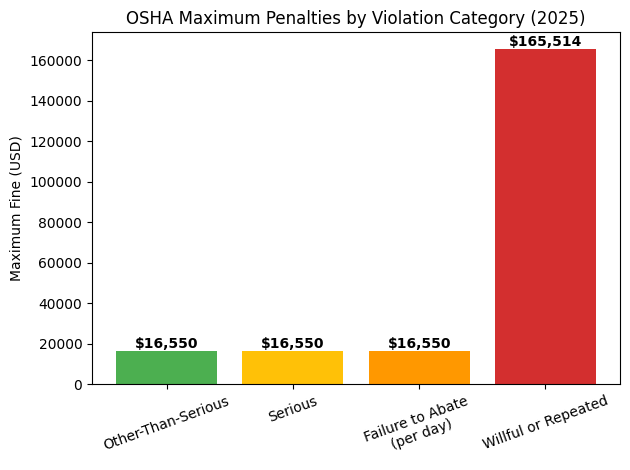
OSHA serious violations can exceed $16,000 per citation, while OSHA willful or repeated violations can surpass $165,000 per violation, but fines are only part of the cost.
Workplace injuries can also result in:
- Increased insurance premiums
- Operational downtime
- Legal exposure
- Damaged reputation
- Decreased employee morale
Lesson #3: Prevention costs less than correction.
Organizations that invest in proactive safety programs avoid both injuries and financial penalties.
https://www.osha.gov/penalties
Preventing Workplace Violations and Safety Incidents
Repeat citations often indicate deeper cultural issues. When production pressure overrides safety procedures, shortcuts become normalized.
Strong safety cultures share common traits:
- Leadership visibly prioritizes safety
- Employees report hazards without fear
- Near misses are investigated
- Corrective actions are verified
Lesson #4: Culture drives compliance.
When safety becomes embedded in everyday operations, violations decline.
Final Takeaway
OSHA’s Top 10 violations are consistent for a reason: the most common workplace hazards are also the most controllable.
By focusing on training, accountability, hazard recognition, and leadership commitment, organizations can shift from reactive compliance to proactive prevention.
Safety isn’t just about avoiding fines. It’s about protecting people — and building workplaces that operate stronger, safer, and smarter.
If your organization continues to see gaps in these areas, now is the time to strengthen training, reinforce accountability, and prioritize prevention.
🌐 All Safety Courses – LBA University
📧 in**@***********ty.org
📞 800.522.4464